The six types at a glance
| Type | What you do |
|---|---|
| Topic | Read two short sentences and pick what they are about (weather, age, family…). |
| Fill in the blank | Choose the right particle, word or connector for the gap. |
| Notices & messages | Read a sign, ad or text message and find the option that does not match. |
| Sentence order | Put four sentences (가)(나)(다)(라) in a natural order. |
| Main idea | Pick the sentence that sums up what the writer thinks or wants. |
| Detail | Pick the option that matches a short passage. |
This grouping is ours, based on the public test format: 40 multiple-choice reading questions, 100 points (topik.go.kr). It is not an official list, and the real test may mix or rename types.
What a question looks like in our practice test
1. Topic — what is it about?
Two very short sentences, one noun to pick. Look for the words that point to a category: numbers with 살 mean age, 월요일 means days of the week.
What is the text about?
저는 스무 살입니다. 친구는 스물한 살입니다.
- ① 시간
- ② 나이
- ③ 가격
- ④ 날짜
Show answer
② 나이 (age). 스무 살 and 스물한 살 are ages.
Tip: learn the small set of topic nouns: 날씨, 나이, 가족, 요일, 날짜, 가격, 직업, 나라, 쇼핑, 운동, 식사, 주말.
2. Fill in the blank — particles, words, connectors
The gap is often a particle (에, 에서, 을/를, 와/과, 로), a verb that fits the situation, or a connector like 그래서 and 하지만. Read the whole sentence before you choose.
- Destination with 가다 → 학교에 갑니다
- Place of an action → 도서관에서 읽습니다
- Result of the sentence before → 그래서; contrast → 하지만 / 그렇지만
Tip: verbs for wearing differ by item: 입다 (clothes), 신다 (shoes), 쓰다 (hats, glasses, umbrellas).
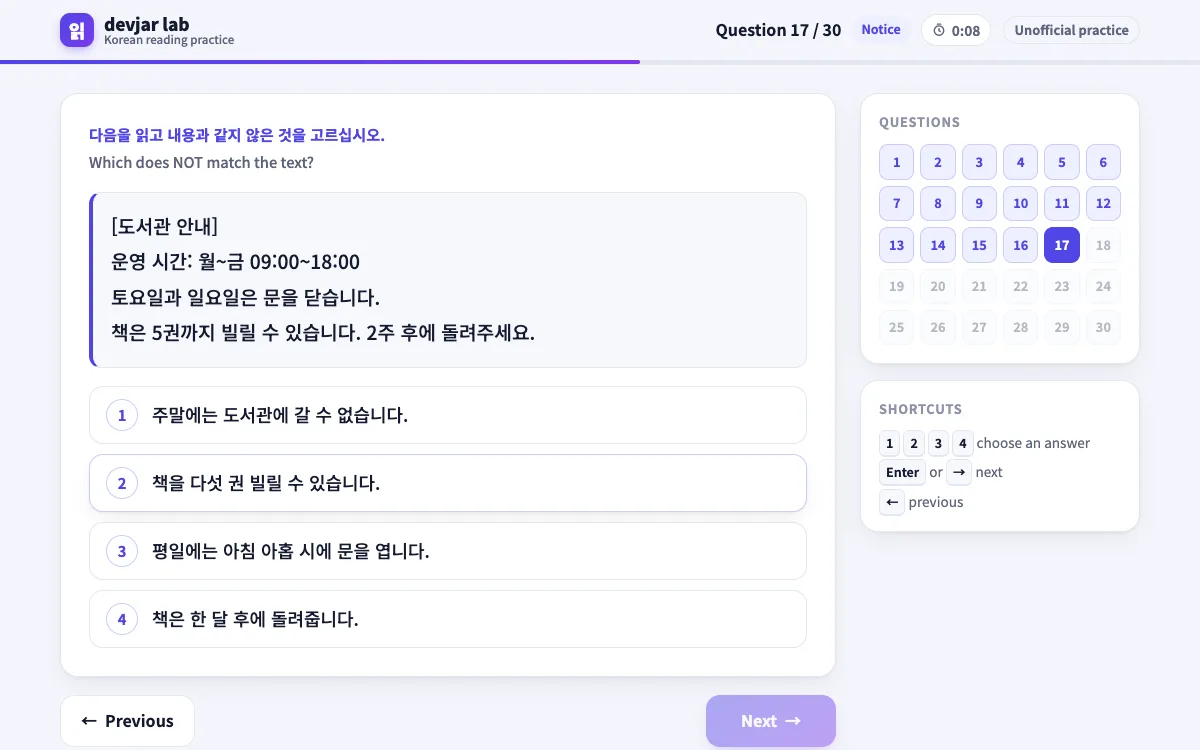
3. Notices & messages — which does NOT match?
You get a short sign, ad or message with times, days, prices and rules. Three options repeat the text in other words. One changes a detail. Check numbers and negatives (않습니다, 없습니다, 안).
Which does NOT match the text?
[도서관 안내] 운영 시간: 월~금 09:00~18:00 토요일과 일요일은 문을 닫습니다. 책은 5권까지 빌릴 수 있습니다. 2주 후에 돌려주세요.
- ① 주말에는 도서관에 갈 수 없습니다.
- ② 책을 다섯 권 빌릴 수 있습니다.
- ③ 평일에는 아침 아홉 시에 문을 엽니다.
- ④ 책은 한 달 후에 돌려줍니다.
Show answer
④. The notice says to return books after 2 weeks (2주), not one month.
Tip: underline every number in the notice first. Most wrong options change a number or a day.
4. Sentence order — put (가)~(라) in order
Find the sentence that can stand first: it should not start with a connector like 그래서 or 그런데. Then follow time words and cause → result.
Choose the correct order.
(가) 그래서 편의점에서 우산을 샀습니다. (나) 아침에 집을 나왔습니다. (다) 그런데 갑자기 비가 왔습니다. (라) 우산이 없어서 걱정했습니다.
- ① 가-나-다-라
- ② 다-나-가-라
- ③ 나-다-라-가
- ④ 나-가-라-다
Show answer
③ 나-다-라-가. Left home (나), sudden rain (다), worried with no umbrella (라), so bought one (가).
5. Main idea
A short paragraph about the writer’s life. The answer is usually in the last sentence, often with -고 싶습니다 or -아/어야 합니다. Wrong options take one detail and stretch it.
Tip: ask “why did the writer write this?” before you read the options.
6. Detail — which matches the text?
The opposite of the notice type: one option is true, three are not. Read each option and find the exact line it comes from. If you cannot point to a line, it is probably wrong.
How to practise these
- Do one type at a time until it feels easy, then mix them.
- Time yourself. The reading section has 40 questions, so leave enough time for the longer passages at the end.
- Review every miss: was it a word you did not know, or a detail you skipped?
How many points do you need? See How TOPIK I is scored: Level 1 vs Level 2.
Try 60 original questions for free
All six types · instant score by question type · explanations for the first 5 questions · no sign-up.
Start practice testAll questions are written by us. No official past exam questions are used. Not affiliated with NIIED.